Showing posts with label Korosko. Show all posts

Saturday, December 3, 2022

"...This Latter Part We Had To Do On Camels..." From Korosko to Akasheh


 Date palms growing along the Nile.  "The natives had to pay a tax to the state for the right of gathering fruite from these trees..."

Underwood & Underwood, photographer. (ca. 1911) A typical Egyptian village in the Nile Valley. Egypt Nile River Valley, ca. 1911. May 22. [Photograph] Retrieved from the Library of Congress, https://www.loc.gov/item/2004672940/.


Page 26

(Page 25 last line from previous post)  "...I asked him...(page 26)...one day if he did not find life monotonous on the top of the mountain alone to which he replied that he preferred being there to the bustle of the camp below. He almost regularly held service in the camp on Sunday evenings & they were enjoyed very much by those who attended them. He was granted a furlough whilst stationed at Korosko but he did not return again for when he got back to Cairo his liberty was redeemed by the American Missionary Society who retained his services as a missionary. To break the monotany (sic) of camp life concerts and theatrical parties used to be organized & carried out very satisfactorily & we were favored several times with original songs, composed & sung by a private soldier of the 79th (Cameron Highlanders). There is very little vegetation in and around Korosko...The Natives would grow their 2 crops of corn a year & then there are groves of date palms...

Page 27

...along the bank of the river & the Natives have to pay a tax to the state for the right of gathering fruite from these palm trees. They yield abundantly in the season, and generally the Natives put the fruite aside & dry them for the less productive seasons of the year. The Natives live very largely on dried dates during the winter & spring. They also use a quantity of dhuroo (dhurra?) a kind of red pea shaped grain peculiar to the Natives themselves.  Cotton is also grown in some parts of Egypt more especially in the lower part of Egypt. Sugar cane is also grown in lower Egypt sometimes 6 or 7 feet high...the cane itself is something in appearance like a bamboo with a large course grass top sometimes 1 1/2 ' or 2' wide. Oxen & camels are the chief kind of animels (sic) used for locomotion & work purposes but seldom you will see oxen yoked except for water raising...carrying is done principally by panniers..."

     Edward M. Spiers wrote about the Cameron Highlanders during their summer in Korosko in his The Victorian Soldier in Africa ;  "...When the soldiers faced lengthy encampments, as the Cameron Highlanders did, they made the best of it."  The Highlanders were based at Korosko for 10 months, and spent their time building mud huts, playing football and cricket, rowing on the river and forming their own theatrical company.

   In October of 1885 they were sent upriver to occupy the small fort of Kosheh which was the most southerly frontier post protecting the 87 mile railway from Wadi Halfa to Akasheh.  After the failure to rescue Gordon and the retreat back down the Nile, the British Government established an Egyptian Frontier Field Force comprised of British and Egyptian troops.  The struggle to stave off the Mahdists continued. 


Our reference map for this area of Egypt and Sudan.  Charles was stationed in Korosko, and then traveled by steamer, train and camel to Akasheh. By this time the Expedition had ended and the assembly of the Frontier Field Forces was beginning. Kosheh was the southern most outpost. 

  From here Charles King's narrative suddenly reverts to his orders to proceed to Akasha (Akasheh).  His timeline seems to fit in with the Highlanders departure date, namely, around October of 1885. He traveled by steamer, train, and then finished his journey by camel....


Page 28

"...after I had been at Korosko about 8 or 9 months & then received orders to proceed to Akasha a place 90 miles above Wadi-Halfa where is the second & longest cataract on the Nile...we done the journey from Korosko to Wadi Halfa by steamer & was not permitted to stay long on our upward journey at Wadi Halfa.  The Egyptian government had previously constructed a Railway from Wadi Halfa to Sarras some 12 miles crossing the worst part of the cataract, our government to make greater dispatch for transport purposes had decided to continue the line 18 miles further on & thus cross the whole of the cataract, so when we were going up we found a good bit of the line laid & was able to travel as far as Ambigul Wells (Ambigol) by train within about 16 or 14 (19?) miles from our destination this latter part we had to do on camels.  This I assure you is anything but pleasant for novices as the motion of the camel is quite....

Page 29

  ...unique and causes great pain to one unused to it...We however got to Akasha after several days travelling & took up our quarters & soon found out what our duties was to be here...It was intended as the Expedition was coming down the river to make this place the frontier station of Egypt so our job was to lay out & construct fortifications...we had several gangs of Native workmen at our disposal & we were kept going for several months at this, but occasionally relieved the monotony by repairing & repainting the boats that had been used in the expedition. I may say that the whole of the boats was whalers (two bow boats about 30 ft long), & fitted with rowing & sailing gear complete for each boat..."  (to be continued)...

**********************************************


"Photograph of Cataract of Ambigole or Second Cataract" Photograph taken in Egypt by Anglo-Italian photographer Felice Beato 1884/5. National Archives UK. The train skirted the second cataract. 


 A rare day of good sailing on the Nile between Sarras and Dal, with voyageurs in the bows of the whalers. Orignally published in the Illustrated London News.  Reproduced from MacLaren 1978: plate 21.

 General Wolseley recruited almost 400 Canadian Voyageurs to help his expedition ascend the Nile.  It was the first time that a Canadian contingent served overseas.  They were recruited because they were known for their exceptional skills in navigating rough waters in small boats.  I can't imagine what they thought of the wild contrast between snow and sub-zero temperatures of their home country to the soaring heat and desert landscape experienced in Egypt and the Sudan. 

  They arrived in Alexandria on October 7th of 1884 and by October 26th had made it to Wadi Halfa to join the British soldiers who had piloted the whalers this far.  The tough work really began here, as the voyageurs encountered the second cataract and by a combination of rowing, sailing and towing from shore made their way slowly up the Nile. They encountered more cataracts, rough current, and submerged rocks that broke their boats apart. It was the Sappers job to repair the boats on the way.  Their navigational skills did help the column advance at a quicker pace through November and December. 

  Wolseley then sent his Camel Column across the Bayuda desert in hopes it would reach Khartoum faster while the River Column continued to fight its way up the river.  By the end of January all hope was lost for the rescue for General Gordon.  The River Column never made it to Khartoum, and the relief mission was now over.  The Column began its journey back down the Nile, at one point descending in 9 days what previously took 30 days to ascend.   On the way they were attacked by the Sudanese army in the battle of Kirbekan, but made it to Korti where General Wolseley let the Canadians continue on to Alexandria and eventually back home to Canada by March of 1885.  (From Voyageurs on the Nile by John Boileau in Legion Magazine Jan. 1, 2004). 

  Charles King, as a sapper, was also given the task of repairing and painting what whaler boats were left from the Expedition while he was stationed at Akasheh.  They were still being used by the  Frontier  Field Force in the fall of 1885.  Charles' service in the Expedition had ended, and he was now a part of the combined forces of the British and Egyptian troops.     To be continued.....
  

Wednesday, November 30, 2022

"There Is No Town At Korosko Only A Village..."


 Korosko, Egypt, on the Nile River.  From a 1912 Post card;  eBay 
The signal station was most likely located on the top of the highest hill, located on the right in this picture.  Korosko disappeared under Lake Nassar, created by the Aswan High Dam, in the 1960's. 


  From here to the end of Charles Kings' description of his trip to Egypt and back we have to toggle between his original manuscript written on the back of the Bazaar flyers, his small notebook  and his final copy written in pen, which he ended in pencil.  It appears that at this point in his narrative Charles either ran out of time in his talk and had to trim quite a bit of detail and extra information, or he wanted to add some of the more colorful and descriptive tidbits of his experiences and was otherwise discouraged in including them (perhaps by his wife Anna? Boils and near drowning may have been too much for his intended audience). I have pieced together the rest of my Great Great Grandfather's  narrative from the remaining pages of his writings.

   In the following pages we get a glimpse of what Charles was doing in Korosko as a Royal Engineer and we also get more details of the expedition itself.  I especially enjoyed his descriptions of  wild life on the Nile....I can just hear the music of the frogs at night.....


  Small notebook, continued from previous post... 

"...There is no town at Korosko only a village but the importance of Korosko lies in the fact of its being the entrance to the pass by which Gordon took this rout (sic) on his journey to Khartoum thus saving several...

Small notebook 

 ...hundreds of mile rout (sic) which from here may be likened unto a D the straight line showing the rout (sic) across the desert from Korosko to Abu Hamed & the circular part that of the river with Korti about the middle of the curve..."
 Map of Korosko in relation to places mentioned by Charles King in this post and subsequent posts (highlighted).  The "D" he refers to here would be in relation to Korosko looking south. 


"...We found here stationed the 79th Cameron Highlanders Regiment, and it then became known to us that we were sent there to commence to build a permanent camp for them...we also found that Major Rundle of the Egyptian Army was organizing a relief party to cross the desert with stores & C (commissary/canned food?) for General Earl's (Earle's) column who was making their...

 Small Notebook

...way up the Nile to reach Berber and ultimately to overtake Stewarts column who were crossing the desert from Korti. You all know that this did not work out in fact as Earl(e) was killed & Gordon was no more & by a lucky coincidence Rundle did not commence his journey across the desert, had he done so it is more than probable that the whole party would have been annihilated... as prisoners who were taken & brought into camp from the desert reported that a very large party were...

 Small notebook

...outside waiting for the expedition to move out to compete their deadly design. We remained at Korosko for several months during which time we had raised accommodations for several hundred of troops & as it was of urgent importance that our work should be got on with, we were obliged to work when the sun was intensely hot.  I here experienced the hottest day that I knew in Egypt namely 125 (degrees) in the shade...I could tell you lots of things that I witnessed during my...

 Small Notebook 

 ...sojourn on the Nile but I must not go further that to take a ramble. I witnessed a tremendous whirlwind at Korosko... paper matting made of palm leaves & things that was laying on the ground was carried up in the air to a tremendous height.  It was here that I first witnessed the manufacture of Egyptian brick, primitive of course made today & dried in the sun  & used tomorrow, we used millions of these brick whilst at Korosko and the native method of making them is as follows. *

Page 23 (on the back of a Bazaar flyer)

*They have a goodly supply of water & they dig up the soil into a kind of pit & 2 or 3 men tread the whole together as the water is allowed to run into the pit & when the whole is brought to the consistency of stiffish mortar it is taken out of the pit in such quantitys (sic) as two men can conveniently carry on a piece of matting such as I named just now. It is then carried to the moulders who, having placed the mould on the ground, the moulder sitting on his haunches fills the mould...lifts it from the brick he has made & again sets the mould in a position alongside the brick last made, thus after continuing this motion from morning till night they have a large quantity of brick covering the surface of the ground. Those made as it were today will be fit to use after having the strength of a days sun upon & they are then collected together and if for immediate use are taken away in panniers on camels backs.  Sometimes straw is used in making the brick & sometimes the stubble from...

 Page 24 

  ...the land after the corn crop has been taken out. I may just say that whilst at Korosko I was almost drowned, having gone down to the river to bathe of Easter Sunday 1885, and as there was a very large number bathing at the same time I was fouled (?) whilst swimming from a small island not far from the shore & lost my stroke & was only just reached when going under water for the third time.  I was also impressed with the reality of the plagues with which god smote the Egyptians in the days of Moses.  I was the recipient of several boils by way of (?), on another occasion we were almost swarmed with flies & almost the whole time I was at Korosko we used to be blessed with frog music...frogs are very numerous there...I remember one night sleeping in our tent which was a square one about 10 ft square with doors open at each end when in the dead of the night I was almost (?) & seeing a wolf run right through our tent on its way from the hills to the river to drink. The wild animals which inhabit the desert and mountainous regions generally make their way to the river for drink at all hours of the night. I did not see any lions whilst I was in Egypt but I was told that one was seen in the deserts a little way out from our camp. One of the Officers in our camp killed a hyena one day & had it brought into camp & stuffed (?)....


Page 25

...I did not see any crocodiles or alligators whilst I was there but I know they frequent the waters further up the river & sometimes they are several together & make it very dangerous to people frequenting the river in any way.  During my stay at Korosko the Nile was quite low but began to rise rapidly before I left to go upward. On the highest hill behind the camp was the signal station & the man who was stationed there could see a good distance over the river in both directions & it was his duty as soon as a steamer hove in sight to signal its approach by hoisting a ball to the flag pole attached to which was an arm each way & so whicher (which ever?) way the steamer was approaching from he would raise the ball indicating the direction...The man who was appointed to this billit (?) was a good man....I have been on the top of the hill for a ramble occasionally & found him devoted to reading his bible or praying or some other religious exercise......"  (to be continued)

**********************************************

 "We found here stationed the 79th Cameron Highlanders Regiment, and it then became known to us that we were sent there to commence to build a permanent camp for them"   ...Who were the Cameron Highlanders? And what was their role in the Nile Expedition?  

 
Internet Archive 
https://archive.org/stream/historicalrecord00grearich/historicalrecord00grearich_djvu.txt

  The Queen's Own Cameron Highlanders (or the 79th of Foot) was a line infantry regiment of the British Army, originally raised in 1793.  Their primary mission during the Nile campaign was to assist in guarding the lines of communication at Korosko; they remained to later join the Sudan Frontier Field Force in 1885. (Cameron Highlanders; Wikipedia)

  According the Historical Records of the 79th Queens Own Cameron Highlanders, the Highlanders arrived in Korosko on the 4th of December, 1884. On the 23rd of January more troops from the 79th arrived in Korosko from Cairo.  On the 28th of January, 1885, the sad news of the fall of Khartoum and the death of General Gordon was communicated to Colonel Leith, the Commandant of the station. 

  An excerpt from the text is as follows...
On the 8th of February the following telegram was received by 
Colonel Leith from Major-General Sir Evelyn Wood, V.C., commanding 
the lines of communication : 

" Your battalion will spend the summer at Korosko ; commence at 
once to hut half a battalion with a view to health and comfort, and 
report progress when half is completed." 

From this it became evident that Lord Wolseley's army would 
summer in the Soudan and advance upon Khartoum in the autumn. 

On receipt of this order the regiment at once commenced to 
construct huts of mud and palm branches, 
  
  The role of the Royal Engineers stationed at Korosko was to oversee the building of these huts.  Charles gave a detailed description of how the mud bricks were constructed.  Did he participate in the making of the bricks, or just the design and construction of the huts?  He didn't say. We do know that he was a part of a small detachment consisting of an officer, a corporal and 4 men (himself included). 

  On the 7th of April, Lord Wolseley himself arrived in Korosko and inspected the work of hutting the Highlanders.  B, C and D companies occupied the mud huts by the 20th of April, and by the middle of May the whole regiment was hutted (from Historical Records...) Charles King was most certainly there in April to meet Lord Wolseley and have his detachment's work reviewed.  

  The Highlanders stayed and eventually went on to defend the Sudan later in the year, with Korosko used an an outpost. The greater part of the expedition forces began leaving Egypt in July of 1885.  (Project Gutenberg's The Egyptian campaigns, 1882 to 1885, by Charles Royle, Chapter 51 Evacuation)


 ******************************************

Sunday, November 13, 2022

"Our Destination Was Korosko a Place Between Assouan & Wady Halfa'.....


The Simoom in the Desert by David Roberts, R.A., signed with the name of the artist. From The Holy Land, Syria, Idumea, Arabia, Egypt, & Nubia, 1855-56. Hathi Trust Digital Library online version of a copy in the Research Library of the Getty Institute. A simoom is a hot, dry, dusty wind blowing in the desert.


 (continued from previous page 11) "....I was one of the first party who went away & our destination was Korosko a place between Assouan & Wady Halfa.  We were not a large party six all told an officer corporal & 4 men.  We left Boulak el Dahrue...

Part II Page 12

 ...by train for  Assouet were (where?) we were to take the mail boat for Assouan & after a long and weary day of travelling we reached Assouet about 11 p.m. We passed the great Pyramids on our way up by train and the appearance of these although generally shown to be perfectly straight at its sides are on the other hand a rugged pile of stone work of immense proportions.  I am unabled to describe them as fully as I would like to as during my stay in Cairo I did not go to see them although many of my friends did.  I do not mind telling you the reason of this & briefly it was because we (were?) working every day of the week whilst in Cairo & as we only had Sundays to ourselves I did not care to go on Sundays, but most of our men who did go used to go about 4 or 5 together.  They would hire a carriage & a pair for the day & take some provisions & spend the day there...The Pyramids are several miles...

 Part II Page 13

 ...from Cairo so that it is necessary to have a day for it.  So now we will resume our journey up the Nile.  Having arrived at Assouet we made our way in the darkness to the landing place where we found the steamer waiting for us which proved to be a stern wheeler & in addition to being the mail boat she was used for ordinary passenger traffic.  We got on board & took up our berth on the elevated deck without covering of any kind and was glad to lay down there notwithstanding we were laying head to head with the native passengers...on the following day we were permitted to see a little of the country through which we were passing for we travelled all night & not very fast...The country that is to say the fertile land after passing Cairo draws in very narrow & especially so after leaving Assouet in places not more than a few yards whilst...

Part II Page 14

 ...at others in may be about 1/4 mile wide & as the natives have to cultivate this ground & they generally grow 2 crops of corn a year & rain is a very scarce thing there they have to raise the water from the river by artificial means for irrigation purposes, which means is of a very primitive character...There are two systems by which they raise the water for irrigation purposes.  One being a peculiar kind of water wheel & oxen & the other by manual labour.  In all their labour the Egyptians generally accompany themselves with a song.  We passed several villages & town(s) on the journey...Notably Luxor, noted for its fine specimens of ruined temples. There is also a monastry (sic) here & I think a station of the American Missionary Society...Edfu is another village where (there) is a fine old ruined temple.  We were privalaged (sic) to stop & land here for 2 hours & we visited the temple & was greatly struck with the faded...

 Part II Page 15

 ...beautiful architecture & the greatness of some of the stones used in building, one measuring 7 ft X 3ft 6in. & I cannot say how thick & it was placed at the top of the building.  After 5 days we arrived at Assouan having travelled nearly 300 miles by rail and about 500 miles by water...near Assouan we saw a very fine specimen of Egyptian art in the shape of stone cutting & carving.  I refer to a very fine temple with just a small entrance door-way cut & carved out on the face of an almost perpendicular cliff.  This temple itself of course is within the doorway and is actually hewen (sic) out of the solid rock a work which must have taken a very considerable length of time & skill....(in pencil) for I am told that the carving within is very fine.  On reaching Assouan our time was so limited that we had only time to load the baggage...


 Part II Page 16 (difficult to read)


...off the train for transport over the rapids (?) after crossing whilst we (continued?) our journey by an old steamer without incident to Korosko taking (?) days."

 At this point in the manuscript the narrative gets a little confusing as Charles switched from pen back to pencil.  I went back and looked at the small notebook he wrote his original Part II in  and found several pages that had  edits and notations.  As far as I can tell, this was how Charles originally wanted to describe his voyage to Korosko on the old steamer,  but he edited out the details for his re-write in pen.  These pages are faded and difficult to read.


Small Notebook 

 (4th line)  "...After 5 days we arrived at Assouan having travelled nearly 300 miles by rail & about 500 by water.  We had not time to look around Assouan on our upward journey but crossed by rail the length of land by which the river is impeded by the first cataract a distance of six (?) miles. At the other end we again took to the river & this time joined the vessel that served for a mail boat, an old paddle...
Small Notebook

 ....wheel vessel that I should say had done a considerable amount of service in days gone by, for we found .....(the rest of the page is faded and not quite readable, but I think he expounds on how bad their mode of travel was)...

Small Notebook

...taken by the crew.  So we preferred to live & (diet?) on deck preferring that to going below with the rats.  It was only 2 days & nights thus we were to be on her so we put the best side outward & as there was nothing of note & interest we agreed to make the best of it and eventually reached Korosko our destination for the time being..." (to be continued...)


 ***********************************************

Map of Ancient Egypt.  The journey to Korosko begins. 
https://www.ancient-egypt-online.com/ancient-egypt-maps.html 
 
  Charles King spent three months in Cairo, fulfilling his duties as a soldier everyday but Sunday.  He was most likely there through mid December of 1884 and was most likely engaged in planning and training activities in preparation for the push up the Nile.
 
   He was then ready to travel with his small detachment  from Cairo, leaving the port of Boulak el Dahrue  (Bulak) to travel first to Assouet (Asyut) by train and then on to Assouan (Aswan) by stern wheeler.  From Assouan he had a short train trip to bypass the first Nile cataract, and then boarded an old steamer for Korosko. He  was assigned to help build accommodations for the incoming troops there. 

  
In Edward M. Spiers The Gordon Relief Expedition (The Victorian Soldier in Africa) 30 July 2018, he describes how the expeditionary force travelled slowly up the Nile by rail and by Thomas Cook Steamers.  Charles King travelled by a mail steamer that was most likely very similar to the one pictured. These steamers were under contract to the Egyptian government to carry mail, government officials and military officials.   This publicity flyer was from 1890-92.   http://www.paddlesteamers.info/Egypt%20Historical.htm

   Meanwhile, the advance column of  Canadians and the whaler boats had been making their way up the Nile, having reached the first cataract by November.  The remainder of the column followed in boats, by foot, by horse or by camel.  December 30th saw the start of the Camel Corps across the Nubian Desert. The Victorian Soldier in Africa    Manchester University Press 2018


 The trip from Assouan to Korosko was on an "old paddle wheel vessel"  that was infested with rats, but otherwise uneventful.  

  ***********************************
  What did Charles King see on his trip up the Nile?......


 Victorians scaling the Great Pyramid of Giza. "A rugged pile of stonework of immense proportions".  Victorian tourists were allowed to climb the Pyramids and even take pieces of rock home with them, something not allowed now.   Charles saw the Great Pyramids from a distance on the train. 
https://www.dailymail.co.uk/travel/travel_news/article-4223852/Vintage-photos-Victorian-tourists-Egypt-s-pyramids.html


 There are many temples along the Nile River, and it is hard to say exactly what temples Charles saw and visited. It is a shame he did not have more time to sightsee on his way to Korosko, but he was, after all, a Royal Engineer with the British Army and had a mission to complete.  The Victorian "Egyptomania" craze which  had begun in the early 1800's was on the increase around this time. Popular travel companies transformed Egypt into the ultimate tourist destination.  The Nile cruise had been created.... 
https://www.epoch-magazine.com/post/the-curse-of-the-victorians-in-egypt-tourists-on-the-nile


 A modern map of the major Egyptian temples from Luxor to Aswan; stops you might make today if you were on a Nile cruise......
https://historiacruises.com/en/itineraries


 A portion of the Great Temple, Luxor,  signed and dated 1857 by Francis Frith. The sand was still being excavated from around the ruins.

Frith, Francis. Egypt and Palestine. 2 vols. London: James S. Virtue, 1858-1859. Hathi Trust Digital Library online version of a copy at the Getty Research Institute. Web. 3 August 2020.


Temple of Edfu.  Charles King stopped here for two hours. 
https://upload.wikimedia.org/wikipedia/commons/7/7f/Temple_Edfou_Egypte.jpg

 Kom Ombo Temple. Charles may have seen this from the steamer on his way up the Nile. 
By Olaf Tausch - Own work, CC BY 3.0, https://commons.wikimedia.org/w/index.php?curid=84219951


  The Philae Temple in its original location.  The first Aswan dam was built in 1898 and began to threaten the temple when the water level rose.  With the building of the High Dam in 1960 plans began to relocate the complex in order to save it from complete inundation.  It now sits on the tiny island of Philae, south of Aswan. 
https://www.journeytoegypt.com/en/discover-egypt/philae-temple-aswan


 The Abu Simbu historic site. Charles may have seen this temple complex on his way to Korosko riding in the old paddle wheel mail boat after going around the first cataract by train.  The temple was carved out of a mountainside in the 1200's BC for Ramses II.  The Great Temple of Ramses II is on the left, and the smaller Temple of Hathor and Nefertari is on the right.  This picture shows a scale model of the original and current location of the temple with respect to the water line of the river. The entire temple complex was relocated in 1959 during the construction of the Aswan High Dam.   The first cataract is now underwater also.   https://en.wikipedia.org/wiki/Abu_Simbel


First Cataract of the Nile...Library of Congress 
  • Good, Frank Mason, 1839-1928, photographer. Between 1850-1860.


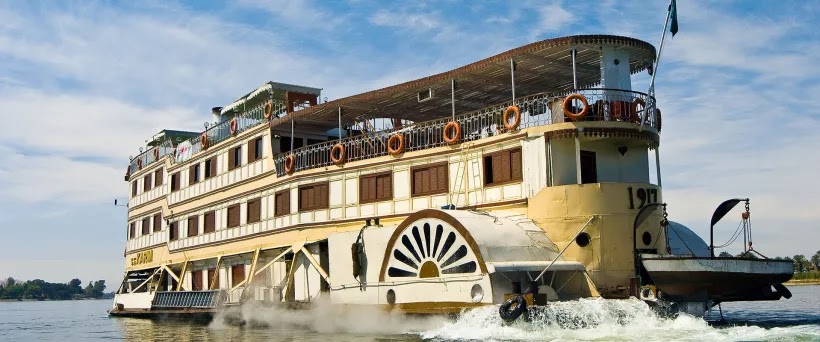
The S.S. Karim, built in 1917 for King Fuad I of Egypt.  It is still powered by its original 1917 steam engine and stern quarter wheel paddles and will take you on a 7 day Nile Cruise in style, starting at only $250 a night.....
https://egyptcitytours.com/hotel/karim-nile-steamer-cruise/