Showing posts with label Royal Navy Whalers. Show all posts

Saturday, December 3, 2022

"...This Latter Part We Had To Do On Camels..." From Korosko to Akasheh


 Date palms growing along the Nile.  "The natives had to pay a tax to the state for the right of gathering fruite from these trees..."

Underwood & Underwood, photographer. (ca. 1911) A typical Egyptian village in the Nile Valley. Egypt Nile River Valley, ca. 1911. May 22. [Photograph] Retrieved from the Library of Congress, https://www.loc.gov/item/2004672940/.


Page 26

(Page 25 last line from previous post)  "...I asked him...(page 26)...one day if he did not find life monotonous on the top of the mountain alone to which he replied that he preferred being there to the bustle of the camp below. He almost regularly held service in the camp on Sunday evenings & they were enjoyed very much by those who attended them. He was granted a furlough whilst stationed at Korosko but he did not return again for when he got back to Cairo his liberty was redeemed by the American Missionary Society who retained his services as a missionary. To break the monotany (sic) of camp life concerts and theatrical parties used to be organized & carried out very satisfactorily & we were favored several times with original songs, composed & sung by a private soldier of the 79th (Cameron Highlanders). There is very little vegetation in and around Korosko...The Natives would grow their 2 crops of corn a year & then there are groves of date palms...

Page 27

...along the bank of the river & the Natives have to pay a tax to the state for the right of gathering fruite from these palm trees. They yield abundantly in the season, and generally the Natives put the fruite aside & dry them for the less productive seasons of the year. The Natives live very largely on dried dates during the winter & spring. They also use a quantity of dhuroo (dhurra?) a kind of red pea shaped grain peculiar to the Natives themselves.  Cotton is also grown in some parts of Egypt more especially in the lower part of Egypt. Sugar cane is also grown in lower Egypt sometimes 6 or 7 feet high...the cane itself is something in appearance like a bamboo with a large course grass top sometimes 1 1/2 ' or 2' wide. Oxen & camels are the chief kind of animels (sic) used for locomotion & work purposes but seldom you will see oxen yoked except for water raising...carrying is done principally by panniers..."

     Edward M. Spiers wrote about the Cameron Highlanders during their summer in Korosko in his The Victorian Soldier in Africa ;  "...When the soldiers faced lengthy encampments, as the Cameron Highlanders did, they made the best of it."  The Highlanders were based at Korosko for 10 months, and spent their time building mud huts, playing football and cricket, rowing on the river and forming their own theatrical company.

   In October of 1885 they were sent upriver to occupy the small fort of Kosheh which was the most southerly frontier post protecting the 87 mile railway from Wadi Halfa to Akasheh.  After the failure to rescue Gordon and the retreat back down the Nile, the British Government established an Egyptian Frontier Field Force comprised of British and Egyptian troops.  The struggle to stave off the Mahdists continued. 


Our reference map for this area of Egypt and Sudan.  Charles was stationed in Korosko, and then traveled by steamer, train and camel to Akasheh. By this time the Expedition had ended and the assembly of the Frontier Field Forces was beginning. Kosheh was the southern most outpost. 

  From here Charles King's narrative suddenly reverts to his orders to proceed to Akasha (Akasheh).  His timeline seems to fit in with the Highlanders departure date, namely, around October of 1885. He traveled by steamer, train, and then finished his journey by camel....


Page 28

"...after I had been at Korosko about 8 or 9 months & then received orders to proceed to Akasha a place 90 miles above Wadi-Halfa where is the second & longest cataract on the Nile...we done the journey from Korosko to Wadi Halfa by steamer & was not permitted to stay long on our upward journey at Wadi Halfa.  The Egyptian government had previously constructed a Railway from Wadi Halfa to Sarras some 12 miles crossing the worst part of the cataract, our government to make greater dispatch for transport purposes had decided to continue the line 18 miles further on & thus cross the whole of the cataract, so when we were going up we found a good bit of the line laid & was able to travel as far as Ambigul Wells (Ambigol) by train within about 16 or 14 (19?) miles from our destination this latter part we had to do on camels.  This I assure you is anything but pleasant for novices as the motion of the camel is quite....

Page 29

  ...unique and causes great pain to one unused to it...We however got to Akasha after several days travelling & took up our quarters & soon found out what our duties was to be here...It was intended as the Expedition was coming down the river to make this place the frontier station of Egypt so our job was to lay out & construct fortifications...we had several gangs of Native workmen at our disposal & we were kept going for several months at this, but occasionally relieved the monotony by repairing & repainting the boats that had been used in the expedition. I may say that the whole of the boats was whalers (two bow boats about 30 ft long), & fitted with rowing & sailing gear complete for each boat..."  (to be continued)...

**********************************************


"Photograph of Cataract of Ambigole or Second Cataract" Photograph taken in Egypt by Anglo-Italian photographer Felice Beato 1884/5. National Archives UK. The train skirted the second cataract. 


 A rare day of good sailing on the Nile between Sarras and Dal, with voyageurs in the bows of the whalers. Orignally published in the Illustrated London News.  Reproduced from MacLaren 1978: plate 21.

 General Wolseley recruited almost 400 Canadian Voyageurs to help his expedition ascend the Nile.  It was the first time that a Canadian contingent served overseas.  They were recruited because they were known for their exceptional skills in navigating rough waters in small boats.  I can't imagine what they thought of the wild contrast between snow and sub-zero temperatures of their home country to the soaring heat and desert landscape experienced in Egypt and the Sudan. 

  They arrived in Alexandria on October 7th of 1884 and by October 26th had made it to Wadi Halfa to join the British soldiers who had piloted the whalers this far.  The tough work really began here, as the voyageurs encountered the second cataract and by a combination of rowing, sailing and towing from shore made their way slowly up the Nile. They encountered more cataracts, rough current, and submerged rocks that broke their boats apart. It was the Sappers job to repair the boats on the way.  Their navigational skills did help the column advance at a quicker pace through November and December. 

  Wolseley then sent his Camel Column across the Bayuda desert in hopes it would reach Khartoum faster while the River Column continued to fight its way up the river.  By the end of January all hope was lost for the rescue for General Gordon.  The River Column never made it to Khartoum, and the relief mission was now over.  The Column began its journey back down the Nile, at one point descending in 9 days what previously took 30 days to ascend.   On the way they were attacked by the Sudanese army in the battle of Kirbekan, but made it to Korti where General Wolseley let the Canadians continue on to Alexandria and eventually back home to Canada by March of 1885.  (From Voyageurs on the Nile by John Boileau in Legion Magazine Jan. 1, 2004). 

  Charles King, as a sapper, was also given the task of repairing and painting what whaler boats were left from the Expedition while he was stationed at Akasheh.  They were still being used by the  Frontier  Field Force in the fall of 1885.  Charles' service in the Expedition had ended, and he was now a part of the combined forces of the British and Egyptian troops.     To be continued.....
  

Wednesday, November 2, 2022

The Nile....Alexandria to Cairo...."My Trip to Egypt Part II"

An aerial view of the Nile river taken from orbit 2003.

Jacques Descloitres, MODIS Rapid Response Team, NASA/sh, Public domain, via Wikimedia Commons


This map shows the Nile in its entirety. The Gordon Relief Expedition had a specific mission.  Khartoum was to be reached by ascending the Nile using modified Royal Navy whalers, and across land by camel. It was a daunting mission. 
https://commons.wikimedia.org/wiki/File:River_Nile_map.svg


 From the beginning of September to the end of October 1884 the expeditionary forces assembled in Alexandria and prepared to travel south to Cairo by steam launch and train. Then,  9,000 men and 40,000 tons of stores and munitions would need to be ferried  from Cairo to Khartoum (1,650 miles) using boats.  The mission was on to rescue Gordon and the city of Khartoum from the siege by the Mahdists that had begun in March of 1884.   

  General Wolseley recruited 386 Canadian voyageurs to navigate the trip up the Nile using modified Royal Navy whalers.  Wolseley had previous experience using these men during an expedition along the Red River, Winnipeg, in 1869,  and thought they would make successful navigators in this expedition. The 800 whalers were transported from England to Egypt.  They could carry twelve soldiers each and enough cargo to supply them for 100 days.  By the 26th of October the Canadians and the boats met up with Wolseley's force of  soldiers at Wadi Hafa and by November they were ready to begin ascending the rapids at the second cataract.     


Nile Voyageurs piloting the whalers with British soldiers up the Nile.  Wood engraving from 1894. 

   https://commons.wikimedia.org/wiki/File:The_Nile_Expedition_for_the_Relief_of_General_Gordon,_from_The_Graphic,_29_November_1894.png


  By Christmas progress  became slow as the boats had to now  be pulled by ropes through the rapids. At this point in the expedition Wolseley knew that time was running out, so he split his force into two columns and sent 2,400 men by camel and horses on a short cut across the Bayuda Desert to reach the city sooner.  The Camel Corp came under attack at Abu Klea on 17 January 1885 and then two days later at Abu Kru. The river column of the remaining whale boats supported by mounted troops continued their difficult journey up the river. 


The Head of the River Column:  Royal Engineers and Guards' Camel Corps Leaving Dongola From the Front. Illustrated London News 86 (3 January 1885): 1. Hathi Trust Digital Library online version of a copy in the University of Chicago Library. Web. 21 August 2020. The Victorian Web. 


Water route highlighted in orange, camel route shown in yellow.  Either route required a great deal of planning and execution to be successful. 
From The Victorian Soldier in Africa Manchester University Press 2018

 
   General Gordon's last entry in his journal was written on the 14th of December 1884 and  read..."Now mark this...if the Expeditionary Force, and I ask for no more than 200 men, does not come in 10 days, the town may fall; and I have done my best for the honour of my country. Good bye".

  On January 26, 1885 Khartoum fell to the Mahdist army and Gordon was killed. The Gordon Relief Expedition failed in its mission as relief arrived just two days after the city fell.  The Camel Corp had managed to meet up with several of Gordon's armed steamers and under the leadership of Colonel Wilson attempted  to relieve the capitol.  They got within sight of Khartoum before turning back due to heavy gunfire. After noticing that the Egyptian flag was no longer flying over Gordon's palace Wilson made the decision to run back downstream as fast as he could.  Getting to Khartoum in time had been a daunting and formidable task at best, and the odds were not in their favor. 

    Wolseley's forces remained in the Sudan until mid-summer, to allow fresh British reinforcements to be assembled in Egypt and then sent up the river. 
 
 From The Victorian Soldier in Africa Manchester University Press The Gordon Relief Expedition 30 July 2018 Edward M. Spiers and...

https://en.wikipedia.org/wiki/Nile_Expedition 

https://www.melik.org.uk/discover/nile-gunboats/send-a-gunboat/

https://legionmagazine.com/en/voyageurs-on-the-nile/

********************************************************


  What was Charles Kings' experience?  He continued writing about his trip in a small notebook, using pencil.  Sometime later he transferred his thoughts to a larger notebook and used an ink pen.  The result was  "My Trip to Egypt Part II" which began with the arrival of the Rewa in Alexandria.  This is his first hand account; what I find especially interesting is how he viewed things from an engineering standpoint. 


Part II Page 1

   "Having arrived at Alexandria, were not long before we were berthed alongside the wharfe in the inner harbour, and as soon as we could we set to work at unloading our stores and baggage, no small task I assure you, for we not only had personal baggage & effects but also a full equipment for field service.  This however proceeded rapidley (sic) and between five & six oclock in the evening all was completed having loaded all on board the train as we were taking it off the ship.  I should mention here the landing accommodation at Alexandria is of an up to date character such as one would expect to find in any European port of any importance. I was particularly struck on first setting foot ashore at the solidity of the wharfes & docks. They are built almost entirely of large granite blocks such as we...


Part II Page 2


...are familiar with in our own country.  The Railway also is brought down alongside for convenience of ships discharging & taking in their cargo.  We were not permitted to go outside the docks at Alexandria, so that having finished our work of discharging, we went aboard ship again and after washing & taking our evening meal we waited until the time of departure for Cairo arrived.  We found the on board the ship in which we had completed our voyage, a very genial party although for the most part first class passengers, yet they seemed to be very much interested in our behavour (sic) and welfare.  We often had an opportunity of peeping into the dining saloon whilst dinner was being served up to the passengers whilst was done in grand style, the tables being waited on by Hindoo waiters who with black faces & snow white outfits & red turbins made rather a picturesque sight.  As a rule these Hindoo's make very...

Part II page 3

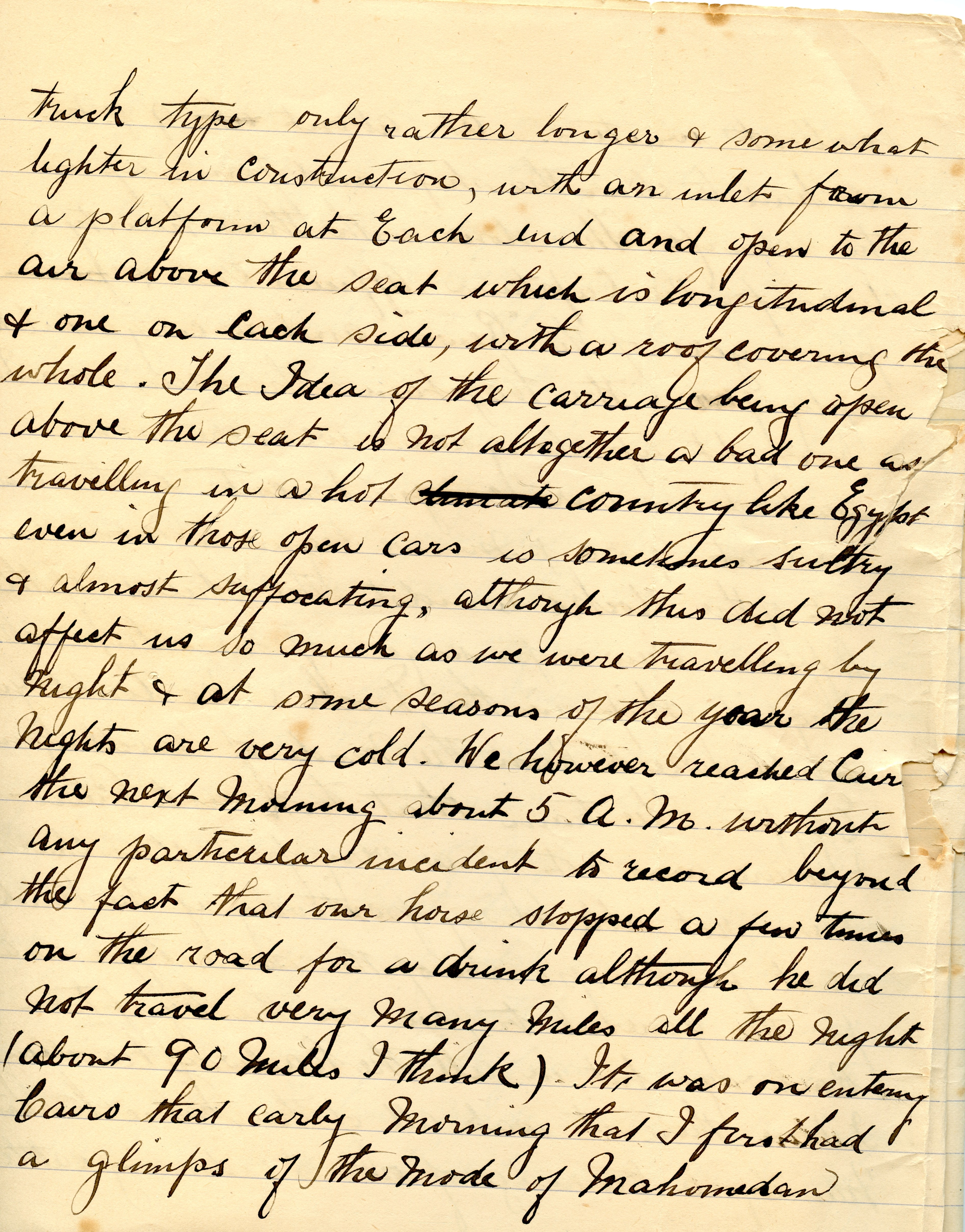
 ...excellent waiters.  At about 9 p.m. we had to clear the ship and form up on the wharfe.  This done with three hearty cheers, for the Captain Officers crew & passengers of the "Rewa" and a congratulatory reply from the Captain the train was brought up alongside & we were soon packed in our compartments of the train and at 9:30 p.m. we began to move slowly out of the docks amidst the cheers of the Officers, crew & passengers of our ship and other English ships in the Docks. No doubt you would like to know the mode of travelling in Egypt.  The train that took us to Cairo I assure you was not a very first class character.  I am not able to say positively if the kind used for troops are of the same type as used for the general traffic on the Egyptian Railways, but in all the Railway traveling I done there it was all of the same character namely a carriage of our  ordinary cattle...

 Part II page 4

 ...truck type only rather longer & some what lighter in construction, with an inlet from a platform at each end and open to the air above... the seat which is longitudinal & one on each side, with a roof covering the whole. The idea of the carriage being open above the seat is not altogether a bad one as travelling in a hot country like Egypt even in those open cars is sometimes sultry & almost suffocating, although this did not affect us so much as we were traveling by night & some seasons of the year the nights are very cold. We however reached Cairo the next morning about 5 a.m. without any particular incident to record beyond the fact that our horse stopped a few times on the road for a drink although he did not travel very many miles all the night (about 90 miles I think)....."

   The horse he is referring to is, of course, the steam train itself!


By train from Alexandria to Cairo is 6 1/2 hours these days, very similar to Charles' train journey. I am sure the passenger cars now are more comfortable than he experienced.   Google Maps.